
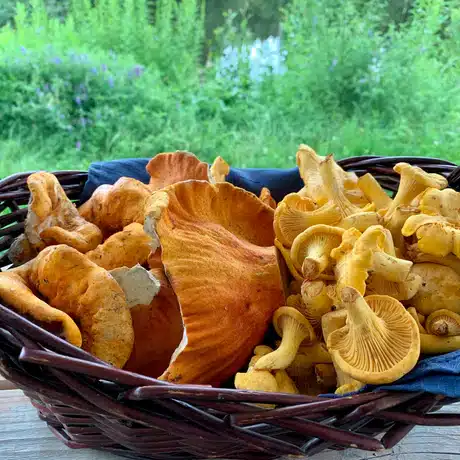
Wild Mushroom Foraging in the Laurentians: A Forest Immersion
A few kilometres from Mont-Tremblant, there is a place where the forest is no longer simply a beautiful landscape.
It becomes a living book.
Upon arriving at this private site dedicated to mushrooms, the first thing you notice is the smell. Damp earth, fallen leaves, decaying wood and the distinctive scent of forest humus.
Then the walk begins.
We look near the roots of trees, beneath the ferns, around old stumps and among the fallen leaves.
Gradually, an entire world that was almost invisible a few minutes earlier begins to emerge.
I had the opportunity to take part in a guided wild mushroom discovery experience. I expected to learn the names of a few species. I left feeling as though I had rediscovered the forest itself.
Wild mushroom foraging in the Laurentians is much more than an ordinary nature walk.
It teaches us how to look at the living world differently.
A Different Outdoor Activity Near Mont-Tremblant
When looking for an outdoor activity near Mont-Tremblant, hiking, cycling, lakes and panoramic viewpoints naturally come to mind.
A wild mushroom experience offers something different.
The goal is not to reach a summit or cover as many kilometres as possible. We move slowly. We observe. We stop.
The landscape is no longer only in front of us.
It is beneath our feet.
A piece of dead wood may support several species. A small shape hidden under the leaves can lead to a fascinating explanation. A mushroom we would normally walk past suddenly reveals complex colours, textures and structures.
The experience is educational without feeling like a classroom lesson.
Everything being discussed is growing directly in front of us.
Entering a Private Mycological Site
The experience takes place on a private forest site in the Laurentians dedicated to growing, observing and discovering mushrooms.
This is not a randomly selected patch of woodland.
The setting makes it possible to explore different areas, encounter cultivated and wild mushrooms and understand the conditions they need to grow.
The connection with nature is immediate.
We hear footsteps moving through the leaves. We feel the moisture in the undergrowth. We search between roots and around tree trunks. Our attention gradually becomes sharper.
When someone finds the first mushroom, the entire group gathers around as though a treasure chest has just been discovered.
Except this particular treasure may have gills, pores or teeth underneath its cap.
Learning to Look at a Mushroom Differently
Before taking part in this type of experience, I mostly noticed the general shape and colour of a mushroom.
I quickly discovered that this was nowhere near enough.
Identifying a mushroom requires the observation of several characteristics: the cap, also called the pileus, the stem or stipe, the flesh, its smell, habitat and especially its fertile surface, known as the hymenophore.
The hymenophore is generally found beneath the cap. Depending on the species, it may consist of gills, folds, tubes, pores or teeth. The way it connects to the stipe can also provide an important identification clue.
Two mushrooms that initially looked almost identical can suddenly appear completely different.
We learn to turn a specimen over carefully and examine the underside of its cap. We notice whether its gills are crowded or widely spaced, whether they connect to the stem and whether the flesh changes colour when handled.
The morel, one of my personal favourites, stands out through its deeply pitted and ridged, almost honeycomb-like cap.
Hedgehog mushrooms have small tooth-like spines beneath the cap, while black trumpets display a dark, hollow and funnel-shaped silhouette.
This is a very different world from the orderly rows of white mushrooms found at the supermarket.
Every species seems to have hired its own designer.
Ancient Knowledge Between Food and Danger
One of the most powerful aspects of the experience is the feeling of reconnecting with ancient knowledge.
For a moment, it is easy to imagine the lives of hunter-gatherers.
Survival depended on understanding the environment, observing seasonal changes and passing down the knowledge required to distinguish nourishment from danger.
One mushroom can be an exceptional food.
Another, sometimes surprisingly similar, can be toxic.
That difference gives the experience real depth. We are not simply collecting unusual names or taking attractive photographs. We are encountering a body of knowledge that demands patience, accuracy and experience.
Caution is therefore essential. The Government of Quebec recommends consuming only mushrooms whose species has been identified with certainty. When in doubt, they should not be collected or eaten, and wild mushrooms must be properly prepared and cooked.
Mushroom identification is not a guessing game won after looking at an app for three seconds.
The forest rewards curiosity.
It rewards humility even more.
Discovering the World of Forestibles
Mushrooms belong to the world of the “Forestibles,” a French term combining the words forêt, meaning forest, and comestibles, meaning edible foods.
Forestibles include edible products derived from forest resources, such as mushrooms, wild berries, plants, syrups and boreal spices. The concept connects the natural environment of the Laurentians with local food and gastronomy.
The mushroom experience brings this idea to life.
The forest is no longer only a hiking destination or a spectacular backdrop. It also becomes a complex and fragile natural pantry.
These resources must be identified correctly and harvested responsibly so that wild populations are not depleted.
The experience therefore teaches us as much about what to leave behind as it does about what we may gather.
A Biodiversity Unlike Anything Else
What impressed me most was the remarkable variety of mushrooms.
Some are tiny and almost translucent. Others are firm, fleshy or irregular. Certain species blend discreetly into the forest floor, while others appear almost too colourful or strangely shaped to be real.
Depending on the season and conditions, participants may encounter morels, hedgehog mushrooms, black trumpets and many other species.
Each discovery creates the same reaction.
We bend down.
We examine the shape.
We look underneath.
We ask for its name.
Then we try to remember the characteristics that may help us recognize it next time.
Five minutes later, the forest usually introduces twelve more candidates.
Learning From an Experienced Specialist
The experience is led by Vincent Leblanc, an agronomist specializing in mycology and a recognized figure within Quebec’s mushroom community.
His background combines mushroom cultivation, wild harvesting, experimentation and education. The value of the experience comes not only from the mushrooms being observed, but also from the person teaching us how to see them.
D-Tour describes him as one of Quebec’s most recognized mycological experts. The activity includes a wild edible mushroom identification workshop and guided foraging on a carefully managed site.
His explanations make technical ideas accessible without oversimplifying them.
Participants can ask questions, compare specimens and understand why a single characteristic is rarely enough to confirm an identification.
From the Forest to the Plate
The experience continues with an outdoor cooking workshop and tasting.
This final stage gives the foraging experience an entirely new dimension.
After observing mushrooms in their natural environment, learning about their structure and understanding the precautions required for safe identification, participants discover how to prepare and showcase them.
We are no longer tasting an anonymous ingredient.
We know where it came from. We remember the environment in which it grew. We understand the knowledge required to identify it and the work involved in preparing it.
The journey from the forest to the plate becomes a story.
And, to be perfectly honest, any mushroom tasted after several hours of discussing mushrooms benefits from an impressive psychological advantage.
An Experience for Nature and Food Lovers
This forest immersion may appeal to:
- nature and outdoor enthusiasts;
- people curious about wild mushrooms;
- food lovers interested in local ingredients;
- visitors who want to learn about Forestibles;
- families looking for an educational activity;
- groups seeking an original experience;
- travellers wishing to discover another side of the Laurentians.
No previous knowledge of mycology is required.
The activity is designed as an introduction, and D-Tour lists it as an easy experience suitable for all levels. Families should confirm any age recommendations and current conditions when booking.
What Stayed With Me After the Experience
When I think back on this experience, the first thing I remember is the smell of the forest floor.
That damp, earthy scent follows us throughout the walk and creates the feeling of being far away from our usual rhythm.
Then I remember the shapes.
The pits and ridges of the morel, the small teeth of the hedgehog mushroom, the dark silhouette of the black trumpet and all the textures we rarely notice while walking quickly through a forest.
More than anything, I remember the feeling of recovering an older form of attention.
We arrive thinking we are going to look for mushrooms.
We leave seeing the trees, fallen wood, soil and leaves in a completely different way.
That is what gives the experience its depth.
Discover Wild Mushrooms With D-Tour
D-Tour offers a guided introduction to wild mushroom foraging in the Laurentians.
The experience includes round-trip transportation from your accommodation, a private driver-guide, the identification workshop, guided foraging, instruction from the mycology specialist, an outdoor cooking workshop and a tasting. D-Tour recommends allowing approximately five hours in total, including transportation and explanations.
You do not need to organize directions to the private site.
D-Tour handles the journey.
All that remains is to bring clothing suited to the weather, comfortable footwear and enough curiosity to look beneath the caps.
Discover the Wild Mushroom Experience
Frequently Asked Questions About Mushroom Foraging in the Laurentians
Where does the activity take place?
The experience takes place on a private mycological site in the Laurentians. D-Tour provides transportation from accommodations in the Mont-Tremblant area.
What will participants learn?
Participants learn to observe the main characteristics used to identify mushrooms, take part in guided foraging and discover a variety of wild and cultivated species.
Can participants eat the mushrooms they collect?
Only mushrooms positively identified by the specialist should be prepared or consumed. The experience includes a supervised cooking workshop and tasting.
Is previous mushroom knowledge required?
No. The activity is designed as an introduction for beginners. The guide gradually introduces the vocabulary and fundamental identification criteria.
How much time should participants allow?
D-Tour recommends allowing approximately five hours for the complete experience, including transportation, explanations and the activities on site.
What is a Forestible?
A Forestible is an edible product derived from the forest. Wild mushrooms, plants, berries, certain syrups and boreal spices are all examples.
How can the activity be booked?
Current availability, prices and booking conditions are provided on D-Tour’s wild mushroom experience page. Private group experiences may also be arranged according to availability. I want to book!